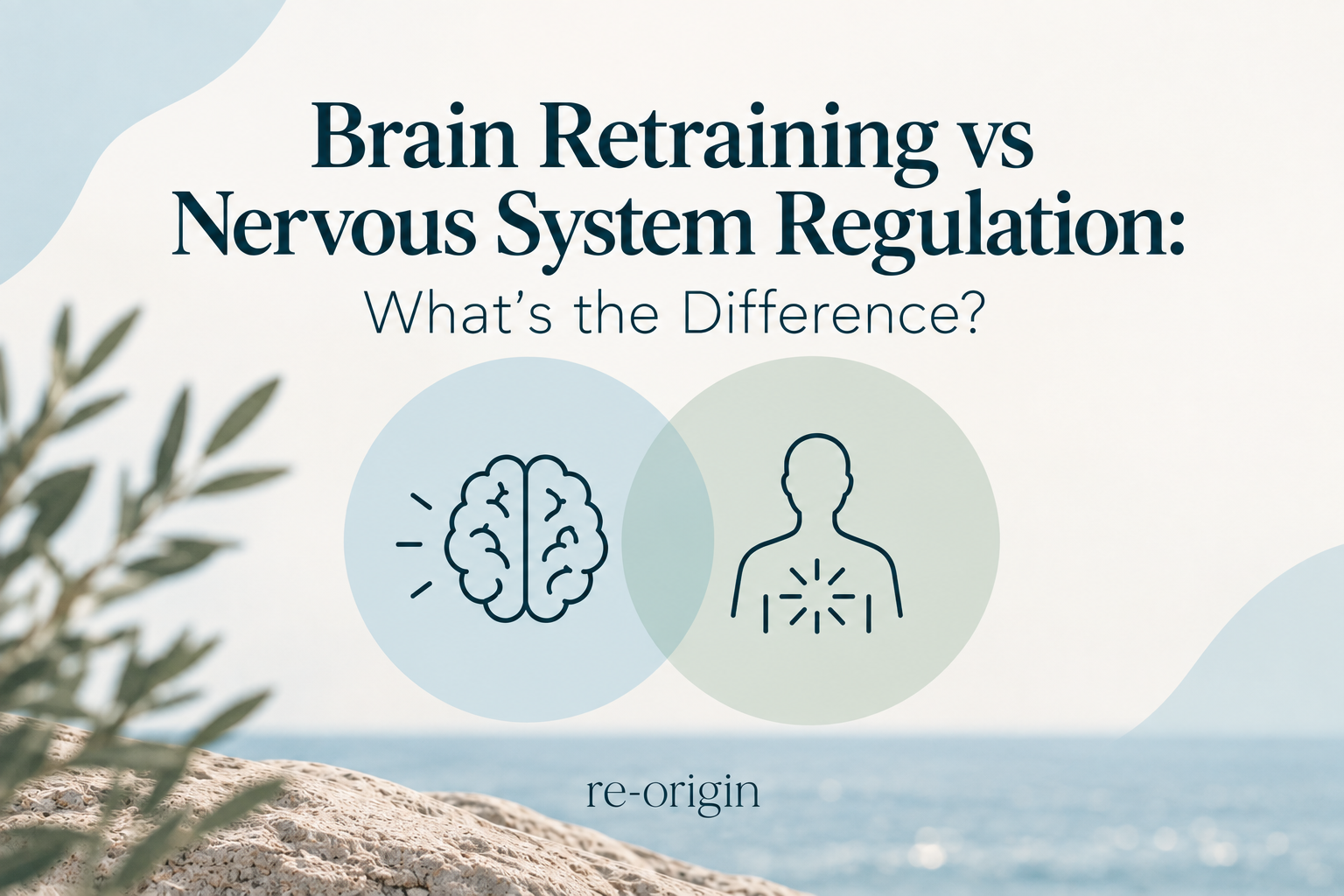
Brain retraining vs nervous system regulation is not necessarily an either-or choice. The two approaches overlap, but they focus on different aspects of how your nervous system responds and learns. Nervous system regulation often helps you work with the state your system is in now, while brain retraining focuses more deliberately on learned patterns that influence how you respond over time.
Regulation might help when you feel highly activated, overwhelmed or on edge. Brain retraining looks more closely at recurring patterns involving attention, interpretation, expectation and behavior, then uses repeated practice to create different responses. For many people, it is not a question of choosing one or the other. They can work together.
Brain Retraining vs Nervous System Regulation: Key Differences
| Nervous system regulation | Brain retraining | |
| Main focus | Your current physiological and emotional state | Repeated learned patterns and responses |
| Typical aim | Support greater flexibility during activation | Practice different responses so familiar patterns become less automatic |
| May include | Breathing, movement, orienting, grounding, relaxation and somatic practices | Attention training, cognitive and behavioral practice, visualization and responding differently to familiar triggers |
| Time frame | Can influence how you feel in the moment | Usually depends on repetition over time |
| Overlap? | Yes | Yes |
The distinction is useful, but it is not a hard biological dividing line. A regulation practice can also create new learning, while repeated learning can change how the body responds.
The main difference between brain retraining and nervous system regulation is their primary focus. Nervous system regulation focuses mainly on supporting your current physiological and emotional state, while brain retraining uses repeated practice to work with learned patterns of attention, interpretation and response.
What Is Nervous System Regulation?
The autonomic nervous system helps coordinate processes such as heart rate, breathing, digestion and physiological responses to challenge. Regulation does not mean staying calm all the time. Activation is a normal part of life, and the more useful goal is flexibility: being able to respond to changing circumstances and recover when the situation changes.
Practices commonly described as nervous system regulation include breathing, movement, grounding, orienting, relaxation and somatic awareness. A systematic review of slow breathing research found changes in measures related to autonomic and central nervous system activity, alongside effects on relaxation and arousal. Most included studies involved healthy participants, so this is not evidence that breathing exercises treat every health condition. [1]
If you want a deeper explanation of the concept itself, see our guide to nervous system regulation or our practical guide on how to regulate your nervous system.
What Is Brain Retraining?
Brain retraining starts from neuroplasticity, the capacity of the nervous system to change with learning and experience. Adult neuroplasticity is well established, although that does not mean every technique marketed as brain retraining has been proven to work for every condition. [2]
At re-origin, brain retraining means structured practice intended to change established patterns of attention, interpretation and response. You can read more about how brain rewiring programs work and the science and everyday examples of neuroplasticity in our dedicated guides.
Imagine that a familiar sensation repeatedly triggers this sequence:
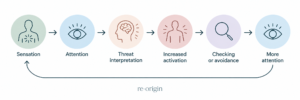
A regulation technique might help you work with the activation once the cycle has started. Brain retraining asks whether parts of the recurring pattern can also change. Could you notice the sensation without automatically giving it the same meaning? Could attention move elsewhere? Could a familiar checking or avoidance response be replaced with something better matched to the present situation?
Brain Retraining vs Nervous System Regulation: State, Pattern and Learning
State is what is happening in your system now. Pattern is what repeatedly happens around particular sensations, situations, thoughts or triggers. Learning is what repeated experience can change over time.
Regulation tends to work most directly with state. Brain retraining deliberately pays more attention to pattern and learning. The same practice can sometimes contribute to both, which is why the two approaches are better understood as overlapping rather than competing.
Why Regulation Can Help Without Changing the Whole Pattern
Suppose you notice your heart beating more strongly than usual. You become concerned, focus closely on the sensation and feel more activated. You use a breathing exercise and gradually feel calmer. The exercise has helped your current state, but the same sequence may still begin again the next time you notice the sensation.
Research into interoception, the way the nervous system senses and interprets signals from inside the body, helps explain why attention and interpretation can matter alongside the signals themselves. [3] A 2024 systematic review and meta-analysis found that anxiety was associated with several self-reported interoceptive patterns, including more negative evaluation and attention toward bodily signals, while also noting mixed findings and measurement limitations. [4]
This does not make physical sensations imaginary. It means that the nervous system does not simply receive bodily information passively. How signals are noticed, interpreted and responded to can become part of the wider experience.
When Regulation Turns Into Constant Monitoring
Regulation tools are meant to increase flexibility, but some people become increasingly focused on checking whether they feel regulated. They monitor their breathing, scan for signs of fight or flight, or feel they must complete a technique before they can continue with ordinary life.
Research from exposure-based anxiety treatment provides a useful, specific example. In inhibitory learning approaches, reducing reliance on certain safety signals can be used to strengthen new learning. [5] That finding does not mean nervous system regulation tools are harmful, and it should not be generalized to every symptom or health condition.
A more useful question is:
Is this tool helping me participate more fully in life, or am I starting to believe I cannot cope without doing it first?
Do You Need to Be Calm Before Brain Retraining?
No. You do not need to be completely calm before brain retraining. Regulation may help if activation is so high that it is difficult to think clearly or try anything new, but complete calm is not a prerequisite for learning.
Sometimes the useful experience is noticing some activation and discovering that you can still continue: staying in a conversation, allowing a familiar sensation to be present without repeatedly checking it, or gradually returning to an appropriate activity that has become associated with fear.
The aim is not to ignore genuine danger or physical limitations. It is to create different experiences when doing so is appropriate.
Is Brain Retraining Just Positive Thinking?
No. Meaningful learning involves more than repeating reassuring statements. Attention, expectations, behavior, context and repeated experience can all matter.
One example comes from a randomized trial of Pain Reprocessing Therapy for primary chronic back pain. The intervention used cognitive, somatic and exposure-based techniques intended partly to change beliefs about the causes and threat value of pain, and it produced greater improvements than placebo and usual care in that specific study population. [6]
This is evidence for a particular intervention in a particular population. It does not mean all chronic pain is caused by the brain or prove that every brain retraining program treats every chronic condition.
Brain Retraining vs Nervous System Regulation: Which Do You Need?
A simple three-question check can help:
- What am I trying to change right now? If the immediate problem is overwhelming activation, regulation may be the most useful first step.
- Does the same pattern keep returning? If a tool helps temporarily but the same trigger, monitoring or avoidance loop repeats, brain retraining may add another layer.
- Is this practice increasing my freedom? A useful tool should generally make it easier to engage with life, not create another rule that must be completed perfectly before you can proceed.
For many people, the most useful answer is both. Regulation can support a more workable state, while brain retraining uses repeated practice to work with patterns that may otherwise keep returning.
How re-origin Brings Regulation and Brain Retraining Together
re-origin combines neuroplasticity education, structured brain retraining, nervous system support and body-based practices. The program also includes community, live classes and access to additional coaching and somatic support.
The longer-term aim is not to spend your life becoming better at calming yourself down. It is to build greater flexibility in how you notice, interpret and respond, so the same situations do not always lead to the same automatic sequence.
Brain Retraining vs Nervous System Regulation? You May Need Both
Nervous system regulation helps you work with what your system is doing now. Brain retraining focuses more deliberately on what your system repeatedly learns to do next.
They overlap, and one can support the other. If regulation tools help temporarily but you still feel caught in the same recurring patterns, a structured approach that includes both regulation and learning may be worth exploring.
Explore the re-origin Program + Community
re-origin provides education and coaching and is not a substitute for medical or mental health diagnosis or treatment. New, severe, unexplained or worsening symptoms should be assessed by an appropriately qualified healthcare professional. Individual experiences vary.