How Connection and Community Support Nervous System Regulation
Nervous system regulation is often described as something you do by yourself. You breathe differently, ground yourself, redirect your attention, move your body or practise a brain retraining technique. Those tools can be useful, but human stress responses do not develop or operate in a social vacuum.
Research shows that supportive relationships can influence how we respond to stress. In some situations, being with or receiving support from somebody we trust is associated with differences in cortisol responses, perceived distress and brain responses to threat. Researchers often describe this as social buffering (Hostinar et al., 2014)[1].
That does not mean another person can simply regulate your nervous system for you. Connection is better understood as part of the environment in which regulation, learning and recovery take place.
For people living with persistent symptoms, that distinction matters.
What Does Nervous System Regulation Actually Mean?
Nervous system regulation is the ability to respond to changing demands and recover afterwards. It does not mean staying calm all the time.
Your heart rate may rise before an important conversation. Your attention may sharpen when something unexpected happens. You may feel tense under pressure and then gradually settle once the situation has passed.
These shifts are part of a normal adaptive stress response.
Difficulty can arise when protective responses become persistent, disproportionate to the current situation or particularly difficult to recover from. For somebody who has lived with long-term stress, trauma or illness, regulation may involve developing more flexibility in how they respond to sensations, uncertainty, emotions and everyday demands.
That can matter to people living with conditions such as chronic pain, ME/CFS, POTS, Long COVID or anxiety, where symptoms, uncertainty and changes to everyday life can create an additional stress load.
These conditions are not interchangeable, and nervous system regulation is not a substitute for appropriate diagnosis or medical treatment. But the way stress, symptoms and uncertainty are experienced can become part of the wider recovery picture.
Connection can influence that picture because the brain does not evaluate a difficult situation using physical information alone. Whether help appears available, who is with us, how we expect another person to respond and what previous experiences have taught us about relationships can all change the context in which a stressful event is experienced.
Why Can Another Person Change the Way Stress Feels?
Researchers have studied this under the term social buffering.
A major review by Hostinar, Sullivan and Gunnar brought together human and animal research examining how the presence or assistance of another individual can reduce aspects of the physiological response to threat or challenge. Much of this research concerns the hypothalamic-pituitary-adrenal, or HPA, axis, one of the systems involved in the body’s stress response (Hostinar et al., 2014)[1].
Human studies give us some idea of what this can look like.
Eisenberger and colleagues asked 30 participants to record supportive social interactions over ten days before completing a laboratory social stress task. Participants reporting more regular supportive interactions showed lower cortisol reactivity during the later stressor. Differences in brain responses to social threat were also associated with both perceived support and cortisol responses (Eisenberger et al., 2007)[2].
This does not establish that social support always lowers cortisol. Cortisol is also not a simple biological score for whether somebody is “regulated.”
What the research does suggest is that social context can become part of the way a stressful situation is processed.
Familiar Support Is Different From Simply Being Around People
More social contact is not automatically better regulation.
One useful study involved 110 participants undergoing a threat-of-shock procedure during brain imaging. They held the hand of either a familiar relationship partner or a stranger.
Handholding with a familiar partner was associated with lower subjective distress and reduced activity across brain networks associated with salience, vigilance and regulatory effort. The same pattern was not found with stranger handholding. Perceived support in the wider relationship was also associated with differences in brain activity while the familiar partner was present (Coan et al., 2017)[3].
This does not mean everybody needs physical touch, nor that holding somebody’s hand is a treatment for nervous system dysregulation.
It tells us something more useful.
The relationship matters.
A person you trust can change the context of a difficult situation in a way that simply placing another human being beside you may not.
That is why advice such as “you need to socialise more” misses something important. You can spend an entire day surrounded by people and still feel isolated, misunderstood or on guard.
What Does Co-Regulation Actually Mean?
“Co-regulation” has become common language in discussions about trauma and the nervous system.
Used carefully, it can describe the way people influence one another’s emotional, behavioural and physiological responses during interaction.
Problems arise when the term is presented as a biological certainty.
You may hear claims that another person “lends you their nervous system”, that two nervous systems automatically synchronise or that somebody else’s calm directly switches your body into a particular autonomic state.
These can work as metaphors. They should not be presented as established physiology.
Research gives us a more complicated picture.
An integrative review examining perceived social support and heart-rate variability, or HRV, identified eight studies. In the majority, greater perceived social support was positively associated with some measures of HRV during rest, stress or recovery, although the evidence base was small (Goodyke et al., 2022)[4].
A later meta-analysis examining perceived social support and acute cardiovascular responses found no significant association with heart-rate, systolic blood-pressure or diastolic blood-pressure reactivity during stress (Landvatter et al., 2025)[5].
That is useful rather than disappointing evidence.
It reminds us that the nervous system is not one dial that connection simply turns down.
Support may influence stress through several routes. It may change how threatening a situation feels, make practical help available, alter our expectations about what will happen next, redirect attention or affect the way we interpret an experience. In some circumstances, measurable physiological stress responses may change too.
That is a more credible understanding of co-regulation than claiming that one nervous system directly resets another.
Why Community Can Matter During Chronic Illness
A trusted relationship can provide one form of support. Community adds something different.
Persistent symptoms can gradually shrink a person’s world.
Plans become difficult to predict. Work or ordinary routines may change. Friends may care deeply without understanding what day-to-day illness feels like. Conversations with family can become dominated by health. Eventually, somebody can feel isolated even when other people are physically present.
This is one reason nervous system work during chronic illness does not always need to happen alone.
A useful community can expose you to perspectives you would not have reached on your own.
Somebody may ask the question you did not know how to articulate. Another person may describe a setback in a way that helps you reinterpret your own. You may notice somebody returning gradually to ordinary life rather than waiting to feel completely symptom-free first. A conversation may remind you of progress that has become difficult to see from inside your own experience.
None of this means the group removes symptoms.
The practical value is that less of the learning, uncertainty and problem-solving has to happen in isolation.
What Does the Research Say About Online Health Communities?
Online community can be particularly important when health, fatigue, mobility, geography or unpredictable symptoms make in-person support difficult.
A 2025 systematic review examined 100 papers investigating online support groups for people with chronic conditions.
The findings suggested potential benefits for social wellbeing, behaviour, decision-making and adjustment. Sharing experiences, exchanging support and social comparison were among the mechanisms researchers identified (Mills et al., 2025)[6].
But the findings were not universally positive.
Evidence for physical-health and quality-of-life outcomes was inconclusive. The review also identified the possibility of increased anxiety or distress, particularly when people were repeatedly exposed to other members’ difficult experiences (Mills et al., 2025)[6].
This is an important limitation.
A community is not automatically beneficial because everybody shares the same diagnosis.
If most conversations revolve around frightening symptoms, worst-case scenarios or constant body monitoring, a group can reinforce exactly the patterns somebody is trying to reduce.
For nervous system work, the quality and culture of the community matter.
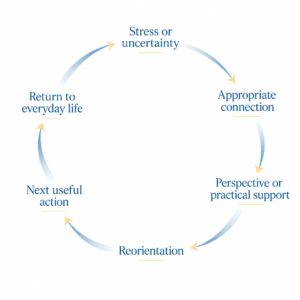
The re-origin Connection-Supported Regulation Loop
At re-origin, one useful way to think about connection is as support around the regulation process, rather than somebody else doing the regulating for you.
The Connection-Supported Regulation Loop looks like this:
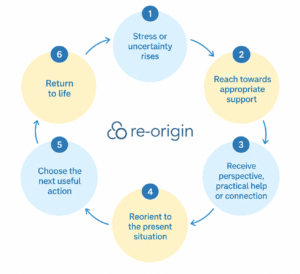
This is a re-origin explanatory model, not a claim that another person directly resets your autonomic nervous system.
The important part is what connection can make easier afterwards.
You might stop searching symptoms long enough to decide what you actually need to do next. Someone may help you recognise that one difficult day is not evidence that everything has gone backwards. You may ask for practical help rather than carrying an unnecessary load alone. A conversation may make it easier to return to dinner, work, a hobby, rest or another ordinary part of life.
Those moments create opportunities to practise different responses in the situations where life is actually happening.
Original visual for this article
THE CONNECTION-SUPPORTED REGULATION LOOP
What Makes a Community Supportive of Nervous System Regulation?
Kindness matters, but it is not enough by itself.
A useful community needs boundaries and a culture that supports flexibility rather than constantly drawing attention back towards symptoms.
That can mean acknowledging a difficult day without turning it into evidence that recovery is impossible. It means allowing people to ask for support without encouraging unqualified medical advice. It means celebrating ordinary progress rather than creating pressure to produce dramatic recovery stories.
It also means allowing different ways to participate.
One person may want regular conversation. Another may prefer to read quietly before contributing. Somebody else may find one-to-one connection easier than a large group.
The goal is not maximum social contact.
It is access to connection that is useful, appropriate and experienced as supportive.
How Community Works at re-origin
Community is part of re-origin’s wider Program + Community, rather than being an unrelated social forum sitting beside the program.
The re-origin Community gives members different ways to connect while they work through the program. Current community features include private conversations, spaces for sharing experiences and progress, guided somatic sessions, visualisations, expert-led workshops, weekly Q&As and themed spaces.
Members who would rather build a more individual connection can use the Progress Pals space to find another member for mutual encouragement and accountability.
Participation does not mean you have to post every day. Some members contribute regularly. Others use the community more quietly, reading discussions and attending the parts that are useful to them. Community support can be used in different ways.
These features are not evidence that the community treats a chronic condition or directly regulates a member’s nervous system.
Their role is to provide more opportunities for support, questions, perspective and continued learning while somebody develops their own skills.
Join re-origin: Program + Community
If you want to learn neuroplasticity and nervous system regulation skills without doing all of the work in isolation, re-origin combines its self-directed brain retraining program with an ongoing private community.
You can work through the program at your own pace while having access to live learning, community discussions, practical resources and support from people who understand what it is like to work on these patterns over time.
JOIN RE-ORIGIN: PROGRAM + COMMUNITY
How to Use Connection Without Making It Another Regulation Rule
It is possible to become rigid about social support too.
If you begin to believe that you cannot cope unless a particular person is available, or that every uncomfortable sensation requires somebody else to reassure you, support can gradually become another way of avoiding uncertainty.
Connection works better as one resource among many.
You might message somebody before a difficult appointment because it helps to know they are there, rather than asking them to convince you that nothing bad will happen.
You might ask a friend to go for a short walk with you instead of spending an hour analysing symptoms.
When asking for help, it can also be useful to say what kind of help you actually want. “Can you listen for five minutes?” creates a different interaction from repeatedly asking, “Are you sure I’m okay?” Asking, “Can you help me work out my next step?” is different again.
Community can also help widen attention.
Conversations about hobbies, work, plans, progress, ordinary frustrations, things you are learning and life outside illness can be as important as talking about a difficult symptom day.
And notice the effect a community has on you. If a particular environment consistently leaves you more frightened, more focused on your body or more convinced that improvement is impossible, more exposure is not automatically useful.
What If Connection Itself Feels Unsafe?
For some people, relationships have historically been a source of stress rather than support.
Trauma, bullying, abandonment, illness-related dismissal or repeatedly not being believed can all influence what somebody expects from other people.
A person may want connection and still become tense when attention turns towards them. Group settings may feel exposing. Asking for help may feel more difficult than doing everything alone.
Protective nervous system responses can be influenced by previous learning and experience, which means greater comfort with connection may need to develop gradually and with choice.
For one person, that could mean reading community conversations for several weeks before posting. For another, one trusted friend or a Progress Pal may feel easier than a group discussion.
If relationships or social situations are associated with significant trauma-related distress or mental-health difficulties, support from an appropriately qualified therapist may be more suitable alongside, or instead of, peer community.
Regulation should increase flexibility and choice. It should not become pressure to remain in an environment that repeatedly overwhelms you.
Community Is Support, Not Treatment
There is an important boundary between supportive connection and healthcare.
Social support can influence the experience of stress. Community can reduce isolation, provide practical perspective and help people continue behaviours they are trying to build.
It cannot tell you what is causing a new medical symptom.
It does not replace medical assessment, psychotherapy, crisis care, rehabilitation or treatment for an underlying condition.
This is especially important in chronic illness. Feeling calmer after speaking to somebody does not establish that a symptom was caused by nervous system dysregulation, just as feeling anxious does not establish that a symptom is dangerous.
Community works best alongside appropriate professional care, not in place of it.
Regulation Does Not Have to Happen in Isolation
Learning how you respond to stress remains personal. Nobody else can practise on your behalf, and another person’s reassurance cannot permanently remove uncertainty.
Connection can still change the conditions in which that learning takes place.
A trusted person may make a difficult situation feel more manageable. A useful conversation can interrupt an interpretation you have been repeating for days. Watching somebody else navigate an imperfect week may make your own setback feel less final. Community can remind you that there is still a life beyond symptoms when illness has taken up too much of your attention.
We do not need to claim that somebody else’s nervous system “resets” yours to recognise the value of those experiences.
For some people, developing greater ability to regulate independently and becoming more able to accept appropriate support happen alongside one another.
If you want a structured way to learn about neuroplasticity and nervous system regulation with an ongoing community around you, re-origin combines both within Program + Community.