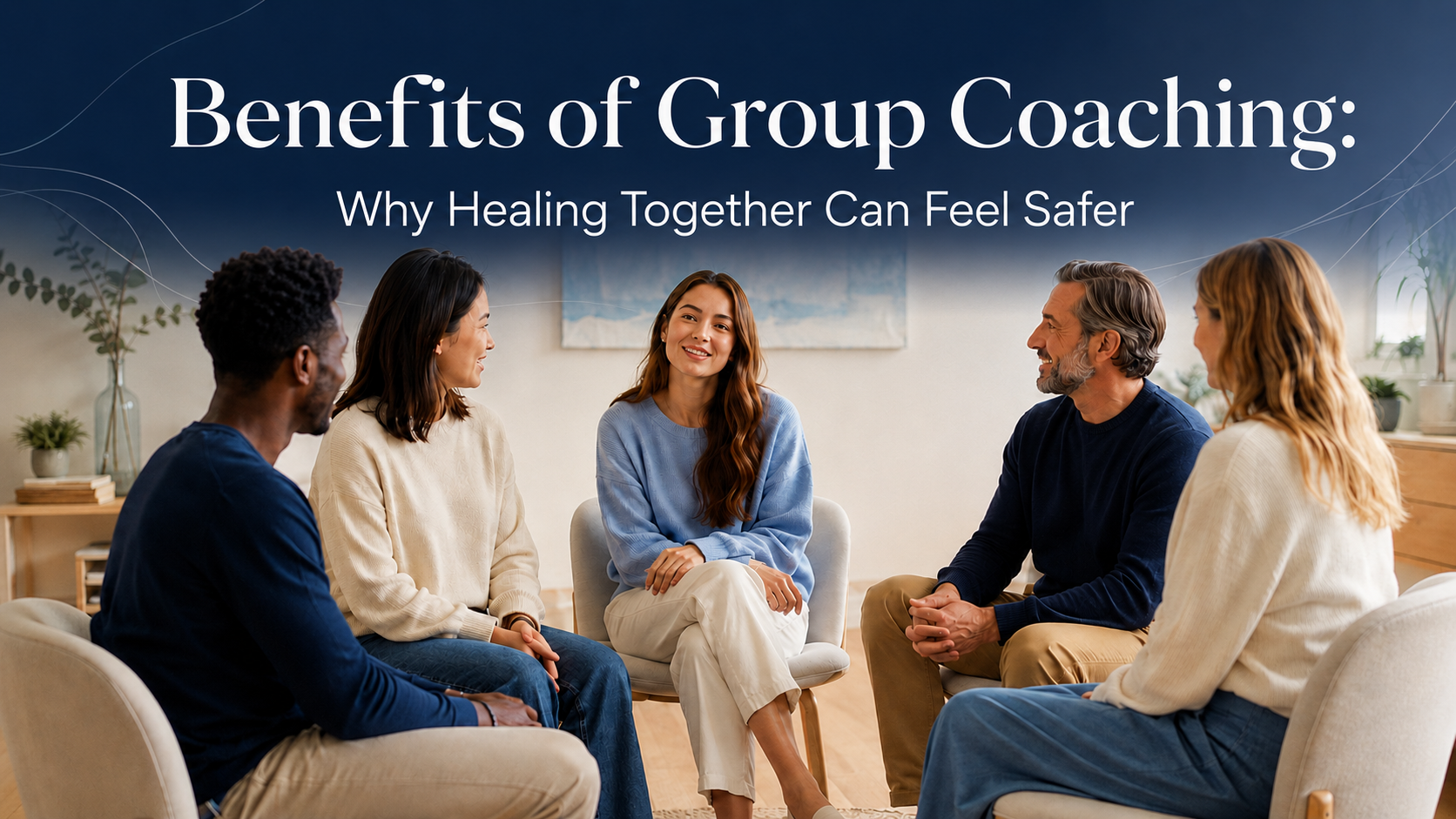
Benefits of Group Coaching: Why Healing Together Can Feel Safer Than Healing Alone
When you have been dealing with a health problem for a long time, doing the work alone can begin to change the way every difficult day feels. A setback can feel like evidence that you are failing. A question can sit unanswered for days. A reaction that would seem ordinary in somebody else can become something you analyse in isolation.
That can be particularly familiar for people living with chronic pain, ME/CFS, POTS, Long COVID or other persistent conditions where progress is rarely perfectly linear and other people may not fully understand the day-to-day experience.
A well-run group can change some of that. Not because other people automatically regulate your nervous system, and not because sharing is always better than privacy, but because familiarity, shared context, choice and good facilitation can make learning feel less lonely and less high-stakes. You hear somebody else ask the question you were nervous to ask. You see that another person has an uneven week and keeps going. You discover that uncertainty is not unique to you.
That is what “safer” means here: not a guarantee of clinical or physical safety, but a greater sense that you can participate, learn and be imperfect without having to manage everything alone.
Why Being With Other People Can Change the Experience
Human beings do not learn, interpret stress or make sense of themselves in isolation. The people around us can provide information. Is this experience unusual? Am I the only one who finds this difficult? What happens if I try a different approach?
Research on social identity is relevant here. A 2026 systematic review and series of meta-analyses covering 106 studies found that social identity processes were associated with objective health-relevant measures. In one group of studies, making a valued group identity more salient was associated with modest reductions in stress biomarkers; in another, threats to social identity were associated with increased cardiovascular reactivity. The important point is not that groups automatically calm the body. It is that social context can matter in both helpful and unhelpful directions. (1)
That distinction is particularly important when we talk about nervous-system work. Connection can support us, but the quality and meaning of the connection matter.
Shared Experience Can Reduce the Sense That You Are the Only One
Persistent symptoms can be isolating even when you have loving people around you. Friends and family may care deeply but still not understand why plans have to change, why a small task can feel enormous, or why progress does not move in a straight line.
A group made up of people doing similar work gives you a different reference point. You do not need identical diagnoses or identical stories. Often it is enough to recognise parts of the process: the uncertainty, the temptation to over-monitor progress, the frustration of a difficult week, the relief when something finally starts to make more sense.
In a qualitative study of women medical trainees who took part in an online group coaching program, participants described building a sense of community as one of three main benefits, alongside learning coping skills and having a customisable experience. That was a specific professional population, so it should not be treated as proof of what every health-coaching group will experience. It does, however, support the idea that community itself can be a meaningful part of group coaching. (3)
Familiarity Matters More Than Simply Putting People in the Same Zoom Room
A room full of strangers is not automatically supportive. For somebody who is socially anxious, highly vigilant, exhausted or used to feeling misunderstood, it may initially feel more demanding than working alone.
What can change over time is familiarity. You start recognising the same faces. You learn how the coach responds when somebody is struggling. You know the rhythm of the session. You see that you can have a quiet week without being judged for it.
This is one reason the current re-origin Momentum Group Coaching format uses the same group across a continuous 10-week period. Continuity does not guarantee comfort, but it removes some of the unpredictability that comes with constantly meeting new people.
You Can Learn Even When the Question Is Not Yours
One of the practical advantages of a group is that you do not have to generate every useful question yourself.
Someone may ask about motivation when you thought your problem was discipline. Another person may describe a thought pattern you had never noticed in yourself. The coach can answer one person while the rest of the group learns from the exchange.
This is different from 1:1 coaching, where the entire session is organised around your individual situation. Neither format is inherently better. The useful question is what kind of support you need at this point.
re-origin explains the distinction in its guide to Group Coaching compared with 1:1 Coaching. Group sessions add shared perspectives and community learning, while individual coaching offers more private and targeted support.
What Actually Helps a Group Feel Safer?
“Safe group” is sometimes used so loosely that it stops meaning very much. A more useful approach is to think about the conditions that can make participation feel more predictable and give people more choice. This is a practical framework, not a validated clinical safety scale.
Predictability matters. Knowing when the group meets, how long it lasts, what the sessions are for and what normally happens next reduces avoidable uncertainty. That can be useful when somebody is already using a lot of mental energy managing symptoms, appointments or day-to-day fluctuations.
Choice matters too. People should not have to disclose personal information simply because they are in a group. They should be able to ask a question, listen, participate at their own pace or decide that a particular discussion is not useful for them.
Familiarity develops when people see the same participants over time. The purpose is not forced intimacy. It is the quieter benefit of knowing who is likely to be there and how the group normally works.
Shared context helps because everybody does not need to begin every conversation with a lengthy explanation. The group does not need identical life stories, but it can help when people are working with a shared set of concepts.
Boundaries also matter. Confidentiality, respectful behaviour, clear coaching scope and an understanding that the session is not therapy or emergency support help define what the space is and what it is not.
Finally, skilled facilitation makes a considerable difference. A coach can prevent a discussion being dominated by one person, redirect unhelpful comparison, clarify program concepts and create room for questions without allowing the meeting to become an unstructured symptom discussion.
You can see the current re-origin coaching team and their backgrounds before deciding whether additional coaching support feels right for you.
Want the Program, Community and the Option to Add Group Coaching?
Momentum Group Coaching is available to active re-origin members as an optional add-on.
If you are not yet a member, the first step is to join re-origin Program + Community. Once you have an active membership, you can purchase Group Coaching through your account when you are ready.
If you want to understand the coaching format before joining, you can also read about Momentum Group Coaching.
A Group Can Normalise Difficulty Without Making Symptoms the Centre of Everything
There is a useful difference between hearing “I understand” and spending an hour repeatedly cataloguing what is wrong.
For people with persistent symptoms, constant comparison and symptom-focused discussion can sometimes become exhausting or increase monitoring rather than reduce it.
Structured coaching should therefore give the group something to do with shared experience. The purpose is not simply to tell illness stories. It is to learn, ask questions, practise skills, notice patterns and keep moving forward.
That distinction is built into re-origin’s current Group Coaching approach. Momentum Groups are structured, coach-led sessions focused on guided learning, skill-building and applying re-origin techniques rather than functioning as an unstructured support group.
Does Group Support Literally “Regulate Your Nervous System”?
Sometimes wellness language makes this sound much more certain than the evidence allows. You may hear that a regulated person automatically regulates everyone around them, or that being in community directly switches the nervous system into safety. Human social physiology is more complicated than that.
There is evidence that social relationships, group identification and social context can influence stress and wellbeing. A meta-analysis of 27 interventions designed to build social identification found an overall positive effect across varied health and wellbeing outcomes, with stronger effects when the intervention actually increased identification with the group. These were different types of interventions, not a trial of re-origin Group Coaching. (2)
At the same time, a 2025 meta-analysis found that individual differences in perceived social support were not significantly associated with acute blood-pressure or heart-rate reactivity to laboratory stress. (5)
That does not mean social support is unimportant. It means we should be careful about using one simple physiological explanation for why connection may help.
A more defensible way to describe it is that social connection can change the context in which learning, uncertainty and stress are experienced.
If you want a broader explanation of stress responses and nervous system regulation, re-origin has a separate guide dedicated to that subject.
What Does Research on Group Coaching Itself Show?
Direct research on group coaching is much smaller than the broader literature on social support, psychotherapy groups or peer support, and available studies often involve specific professional populations.
One randomised clinical trial involving 101 female resident physicians tested a six-month online group coaching program. Compared with controls, participants in the coaching group showed improvements in emotional exhaustion, impostor-syndrome scores and self-compassion, while several other outcomes did not differ significantly. The study provides useful evidence that structured online group coaching can influence some wellbeing outcomes, but it is not evidence that group coaching treats chronic illness. (4)
That boundary matters.
The most defensible reason to choose group coaching is not because research proves that healing in a group is universally superior. It is because the format may offer useful things that solo work cannot: shared questions, repetition, perspective, accountability and a consistent social learning environment.
When Healing Together Does Not Feel Safer
For some people, a group is exactly the wrong starting point.
Previous experiences of judgement, bullying, coercion or poorly run support spaces can make group settings feel exposed. Social anxiety can make speaking on Zoom difficult. Severe fatigue or sensory sensitivity can make a live session demanding. Others simply think more clearly one-to-one.
Those responses do not need to be argued away. A good group does not require everybody to love groups.
If you are deciding whether to join, some useful questions are whether you understand the format, whether you have meaningful choice about how much you share, whether the boundaries are clear, whether there is a facilitator, whether the group has a defined purpose and whether another type of support remains available if the group is not right for you.
re-origin offers both Group Coaching and individual support options, and participation in Group Coaching is not required to use the core program.
How re-origin Structures Momentum Group Coaching
The current Momentum Group Coaching format consists of 10 weekly live online sessions of approximately 60 minutes, with the same group meeting across the coaching period.
Sessions are led by a re-origin coach and organised around different parts of the program. Members can also use a private space for questions and encouragement between sessions. The emphasis is structured learning and skill-building rather than an unstructured support-group format.
Camera use is encouraged where possible but is not mandatory, and Group Coaching is purchased separately as an optional add-on by active re-origin members.
For the current format and upcoming cohorts, always use the live Momentum Group Coaching page rather than relying on older material elsewhere on the site.
What re-origin Participants Have Reported
First-party feedback can tell us how members experienced the group, but it should not be confused with clinical outcome data.
Among 130 surveyed re-origin Group Coaching participants, 96% reported that the group environment supported their healing, 95% said their questions were answered clearly and completely, and 87% said they left sessions feeling hopeful and motivated.
These are self-reported experience measures. They are not cure rates, recovery statistics or evidence that Group Coaching caused a particular medical outcome.
For the shorter summary, see the benefits of Group Coaching at re-origin.
The Most Useful Part of a Group May Be Perspective
When you work alone, your own experience is the only example available in real time. That makes it easy to over-interpret a difficult day or assume that everyone else is progressing more smoothly.
A group widens the sample.
You see people move at different speeds. You watch somebody understand a concept that confused them the week before. You hear a question that changes how you think about your own practice. Progress becomes less like a private exam and more like a learning process.
That can change the emotional weight attached to getting something wrong, asking for help or having an imperfect week.
Healing Does Not Have to Become a Group Project
Healing together does not mean handing your recovery to other people. It does not mean comparing yourself constantly or needing a group in order to make progress.
The value of a good group is almost the opposite. It can give you enough support, perspective and structure to continue doing your own work without feeling that every question has to be solved alone.
For some people, that changes the experience substantially. The work is still yours, but the learning environment becomes shared.
If that kind of structure appeals to you, Momentum Group Coaching is available as an optional add-on for re-origin members.
Start by joining Program + Community. Once your membership is active, you can purchase Group Coaching through your account.