Understanding the connection between menopause, neuroplasticity, and nervous system regulation, and how to start feeling more like yourself again.
You used to handle stressful situations without giving them much thought.
A difficult conversation, an unexpected change of plans, a demanding day at work. You dealt with it and moved on.
But lately, something feels different.
A small inconvenience leaves you overwhelmed. You find yourself crying over things that wouldn’t normally upset you. Your heart races unexpectedly, your sleep is disrupted, and sometimes even ordinary environments feel like too much.
You might find yourself wondering:
Why am I reacting like this? Why can’t I handle things the way I used to? What happened to the person I was before?
For many women, these experiences can emerge during perimenopause and menopause. And while hormonal changes are often discussed in terms of hot flushes and physical symptoms, their relationship with the brain and nervous system deserves just as much attention.
In a recent episode of the Hello Hot Flash podcast, re-origin co-CEO Natalie Rivans joined host Stephanie Shaw to explore why menopause can change how we experience stress, what neuroscience tells us about these changes, and how neuroplasticity may help us develop healthier responses.
Menopause Isn’t Just a Hormonal Transition. It’s a Brain Transition, Too.
Estrogen does much more than regulate reproductive health.
The brain contains estrogen receptors, and estrogen interacts with systems involved in mood, sleep, temperature regulation, and the stress response.
During perimenopause, estrogen levels don’t simply decline in a smooth, predictable way. They can fluctuate considerably, while changes in ovulation also affect progesterone exposure.
For some women, this transition can influence how sensitive they feel to stress and how easily they recover from emotionally demanding experiences.
Something that once felt mildly frustrating might suddenly feel overwhelming. A busy supermarket might become uncomfortable. A disrupted night’s sleep might leave you feeling unusually vulnerable the following morning.
These experiences aren’t necessarily a reflection of your personality or ability to cope.
They may reflect a combination of hormonal fluctuations, sleep disruption, existing stress, and the way your nervous system is responding.
Importantly, not every woman experiences these changes in the same way. Menopause is highly individual, and symptoms should never automatically be attributed to hormones without considering other possible causes.
Why Your Brain Can Become More Sensitive to Stress
Your brain is constantly interpreting information from both your body and the world around you.
One of its important functions is predicting potential threats and preparing you to respond.
But sometimes, the brain learns to interpret particular sensations or situations as more threatening than they actually are.
Imagine experiencing a sudden hot flush while you’re out with friends.
You notice the heat rising. Your heart begins beating faster.
Then the thoughts arrive:
What if this gets worse? What if everyone notices? What if I can’t control it?
Those thoughts may increase your sense of alarm, making you more aware of your heartbeat, temperature, and other bodily sensations.
Before long, the fear surrounding the original sensation can become almost as distressing as the sensation itself.
This doesn’t mean the hot flush is imaginary or that you’ve created it through your thoughts.
The hormonal and physical experience is real.
But the brain’s learned response to that experience can sometimes add another layer of distress.
And that additional response is something we may be able to work with.
Neuroplasticity: How the Brain Learns New Responses
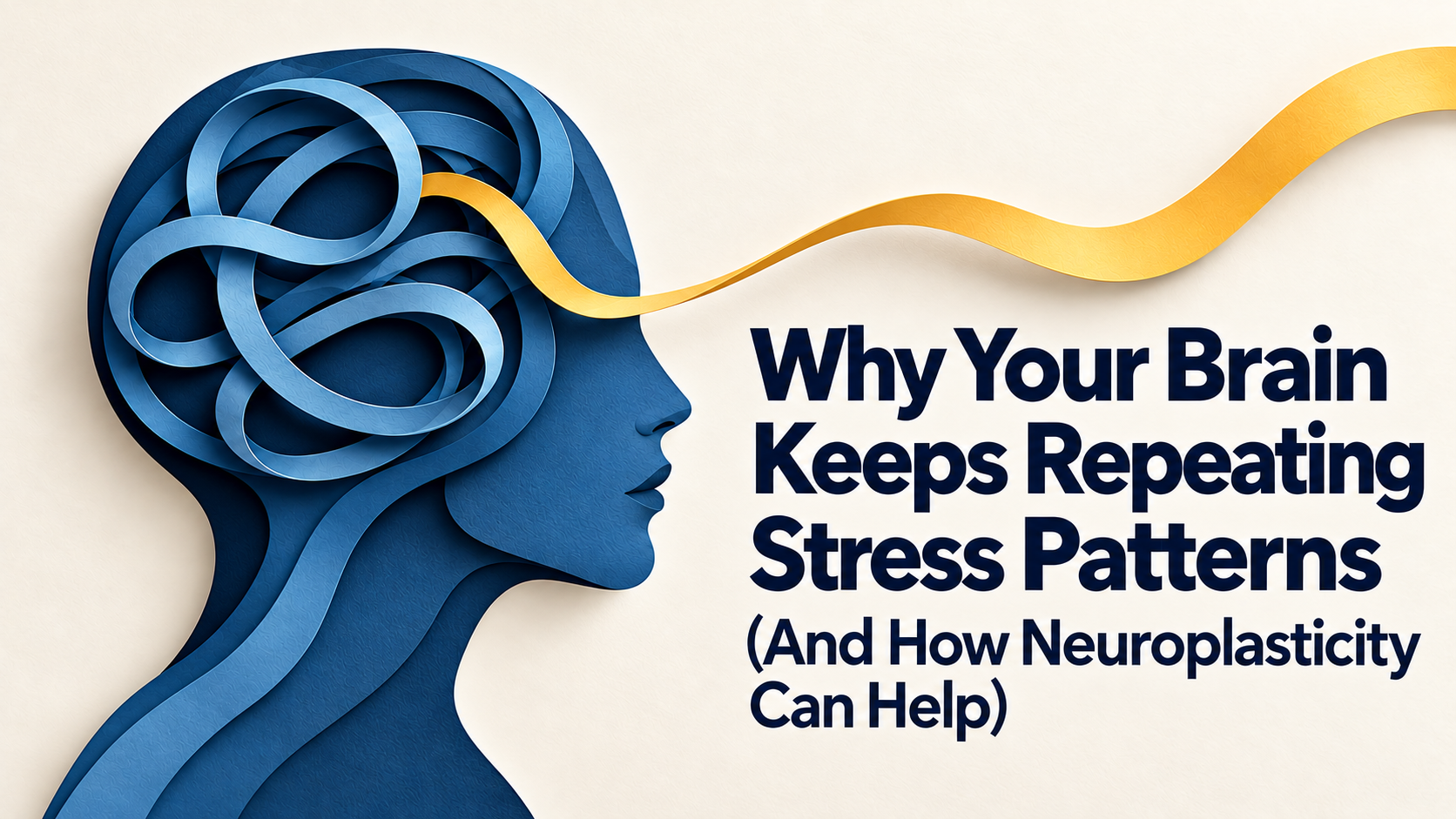
Neuroplasticity describes the brain’s ability to adapt and change through experience.
It’s how we learn new skills, develop habits, and become more comfortable with things that once felt unfamiliar.
But the same learning processes can also contribute to automatic stress responses.
If your brain has repeatedly associated a particular sensation with danger, that response can become familiar and fast.
Natalie describes this using the analogy of two roads.
Imagine your existing stress response as a wide, well-travelled road. You’ve taken it so many times that your brain can follow it almost automatically.
Now imagine creating a second road.
Initially, it’s narrower and less familiar. Choosing it takes more conscious effort.
But each time you practise responding differently, that alternative route becomes easier to access.
The original road doesn’t necessarily disappear. And during particularly stressful moments, your brain may still return to it.
That doesn’t mean your efforts have failed.
It means learning takes repetition.
The goal of brain retraining isn’t to eliminate every uncomfortable sensation. It’s to develop greater flexibility in how you respond to those sensations.
Your Brain Can Learn New Patterns. RENEW Helps You Put That Into Practice.
Understanding what’s happening in your brain is an important first step. But meaningful change takes more than knowledge alone.
RENEW by re-origin is our menopause-focused program, bringing together neuroscience-informed brain retraining, nervous system regulation, and practical mind-body techniques to help you navigate this transition with greater confidence.
Because menopause isn’t just something you have to push through. It’s a chapter of life you deserve to feel supported through.
Coping With Stress Isn’t Always the Same as Changing Your Stress Response
Many women become exceptionally good at coping.
They push through exhaustion, manage responsibilities, care for others, and continue functioning even when they feel overwhelmed internally.
From the outside, everything looks fine.
But inside, their shoulders are tense, their thoughts are racing, and their nervous system feels constantly activated.
Coping strategies can be valuable. Sometimes they’re exactly what helps us get through a difficult situation.
But coping alone doesn’t necessarily change the automatic patterns that keep returning.
This is where brain retraining introduces a different question.
Instead of asking only, How can I get through this moment?
We can also begin asking:
What response am I practising, and what might my brain learn from it?
That shift creates an opportunity to respond more intentionally, rather than automatically following a familiar pattern of fear, avoidance, or excessive monitoring.
A Simple Nervous System Exercise: Notice, Name, Choose
One of the practical tools Natalie shares in the podcast is a technique called Notice, Name, Choose.
It’s designed to create a small pause between experiencing nervous system activation and reacting to it.
Step 1: Notice
Begin by observing what’s happening without immediately trying to change it.
Perhaps your chest feels tight, your thoughts are racing, or you’re beginning to feel overwhelmed.
Simply acknowledge the experience.
I’m noticing tension in my body. I’m feeling overwhelmed right now.
Step 2: Name
Identify the response without making it part of your identity.
Instead of telling yourself, I’m an anxious person or I can’t handle this, try recognising the pattern.
My nervous system is activated, and I’m feeling the urge to escape this situation.
This helps create some distance between what you’re experiencing and who you are.
Step 3: Choose
Now choose one small, supportive action.
You might soften your shoulders, look around the room, feel your feet against the floor, or take a gentle breath.
You don’t have to make the feeling disappear.
The aim is simply to practise a different response.
Over time, repeated experiences like these may help you develop more flexible ways of responding to stress.
Why Somatic Practices Can Help During Menopause
Sometimes, understanding intellectually that you’re safe isn’t enough to make your body feel settled.
You might know that an upcoming meeting isn’t dangerous, yet still experience a racing heart and tense muscles.
Somatic practices bring attention to the body’s sensations, movement, and physical experience.
Rather than relying entirely on changing your thoughts, they offer another way to practise responding to stress.
For example, you could try a brief grounding exercise:
- Look around. Identify three ordinary objects in your surroundings.
- Feel your body. Notice the contact between your feet and the floor or your body and the chair.
- Breathe gently. Allow your breathing to remain comfortable, slightly lengthening your exhale if that feels natural.
- Take one small step. Drink some water, move into another room, or return to a manageable task.
The intention isn’t to force relaxation or ignore genuine symptoms.
It’s to reconnect with your surroundings and create an opportunity for a steadier response.
Different techniques work for different people, and some practices may need adapting depending on individual symptoms or circumstances.
Small Steps Can Be the Beginning of Something Bigger
Practices like these can be a starting point. But knowing which tools to use, when to use them, and how to build consistency can make the process feel much more manageable.
That’s part of what we explore in RENEW, re-origin’s dedicated menopause program.
Through neuroscience-informed education, brain retraining, and practical mind-body tools, RENEW is designed to support women in understanding their changing nervous system and building skills they can use in everyday life.
Progress Doesn’t Mean You’ll Never Feel Anxious Again
One of the most important messages from Natalie’s conversation is that progress doesn’t have to mean eliminating every symptom.
Hormonal fluctuations may continue. Difficult days will still happen. Your nervous system may sometimes respond strongly to stress.
But perhaps the reaction no longer dominates your entire afternoon.
Perhaps you notice the familiar pattern sooner.
Perhaps you recover from an overwhelming moment more easily, or feel more confident navigating situations that once seemed intimidating.
These changes matter.
Brain retraining is not an instant solution, nor is it a replacement for appropriate menopause care, medical treatment, or psychological support.
But learning to recognise and respond differently to automatic stress patterns may become one valuable part of a broader approach to wellbeing.
And you don’t have to master everything at once.
A few minutes of practice, repeated consistently, can be a meaningful place to begin.
You Deserve More Than Just Getting Through Menopause
If you’ve spent months wondering why you feel more anxious, overwhelmed, or disconnected from yourself, there’s something important to remember:
You don’t have to approach this transition with willpower alone.
Your body is changing. Your brain is adapting. And with the right understanding and support, you can begin developing a different relationship with stress, your symptoms, and yourself.
That’s why we created RENEW.
Developed by re-origin, RENEW brings together neuroscience-informed brain retraining, nervous system regulation, and practical tools to support women through the emotional, cognitive, and physical challenges of menopause.
It’s designed to help you better understand what’s happening, explore ways to respond to stress, and build supportive practices that fit into real life.
Not to promise a symptom-free life, but to help you feel more informed, supported, and empowered as you navigate this next chapter.
Because you deserve more than just pushing through. You deserve to feel like yourself again.
Discover RENEW: Our Menopause Program
This article was inspired by Natalie Rivans’ conversation with Stephanie Shaw on the Hello Hot Flash podcast.
The information provided is educational and does not replace individual medical advice. Menopause symptoms can have multiple causes, and new, severe, or persistent symptoms should be discussed with an appropriate healthcare professional.