What Is Brain Retraining? How Neuroplasticity Can Change Learned Patterns
Brain retraining is a broad term for practices designed to change established patterns of attention, interpretation, expectation and response through learning and repetition. It draws on neuroplasticity, the nervous system’s capacity to adapt in response to experience.[1,2]
The science of neuroplasticity is well established. Brain retraining itself is not one standardised treatment, however. Different approaches use different methods and target different problems, so the evidence needs to be considered in relation to the particular technique and outcome being discussed.
In simple terms, brain retraining is deliberate practice intended to help a different response become easier to access over time.
What Does Brain Retraining Mean?
Your brain is continually learning from experience.
Think about learning to drive. At first, changing gear, checking mirrors, judging distance and watching other traffic can require considerable concentration. With enough practice, many of those actions become increasingly automatic.
Similar learning processes influence far more than physical skills. Patterns of attention, expectations, habits, emotional responses and avoidance can also become familiar through repetition.
Brain retraining attempts to work with that capacity deliberately.
Depending on what somebody is trying to change, it might involve:
- noticing an automatic response
- changing where attention is directed
- questioning an established interpretation
- practising a different behaviour
- mental rehearsal or visualisation
- gradual exposure where appropriate
- somatic exercises or other sensory exercises
- repeating a new response in different situations
Brain retraining is therefore broader than cognitive “brain training” games designed to practise memory, processing speed or another specific cognitive skill.
For a deeper explanation of the underlying biology, see re-origin’s guide to neuroplasticity and how the brain changes.
How Does Neuroplasticity Make Brain Retraining Possible?
Neuroplasticity describes the nervous system’s ability to change its function, organisation and connections in response to experience.
The adult brain was once viewed as relatively fixed. Research over several decades has shown that it remains capable of substantial adaptation throughout life.[2]
Learning can alter the strength of communication between neurons and the way neural networks operate. Experience can also be associated with measurable structural changes.
A 2026 systematic review examined 30 human MRI studies and found evidence of short-term changes following experiences including motor learning, spatial learning, language training and exercise.[1] The researchers also cautioned that some apparent rapid structural changes may partly reflect temporary changes in factors such as blood flow or extracellular fluid.
So neuroplasticity is real, but phrases such as “rewiring your brain” are best understood as shorthand. The brain is not being rewired like an electrical circuit.
How Learned Patterns Can Become Automatic
One useful way to think about learning is to look at the sequence around a repeated response:
Cue → expectation or interpretation → response → action → feedback → future learning
This is a practical model, not a literal map of everything happening in the brain.
Suppose somebody repeatedly experiences anxiety in a particular situation. They may begin expecting the situation to go badly before it even happens. That expectation can increase monitoring, influence physical responses and shape what they do next.
If leaving the situation brings immediate relief, that relief can reinforce avoidance. When a similar situation comes up again, the learned response may appear more quickly.
This helps explain why some reactions can feel as though they have happened before we have consciously decided how to respond.
Learning research gives us clear examples of these processes. Threat associations can be learned, and later experiences can also change how somebody responds to previously learned cues.[3,4]
Changing the Pattern
Changing a learned pattern is usually more complicated than simply telling yourself to think differently.
A retraining process involves creating new experience.
Someone might notice that a familiar response is beginning, interrupt enough of the usual sequence to try something different, and then allow what happens next to provide new information.
That different response does not always mean “calming down.” It might mean redirecting attention, staying with an experience rather than immediately avoiding it, moving differently, reducing checking or reassurance seeking, or choosing a behaviour that is less driven by the old prediction.
With repetition and variation, alternative responses can become easier to access.
Research into fear extinction and exposure therapy is useful here. Modern inhibitory-learning approaches do not necessarily assume that an old fear memory has simply been deleted. Instead, new learning can compete with the previous prediction and influence what happens the next time the cue appears.[3,4]
An old reaction can therefore reappear occasionally without meaning that previous progress has disappeared.
For practical examples of exercises sometimes used in this area, see limbic system retraining exercises.
What Neuroplasticity Proves, and What It Doesn’t
This is an important distinction when discussing brain retraining.
The fact that neuroplasticity exists tells us that the nervous system is capable of change. It does not automatically prove that a particular brain retraining programme produces a particular health outcome.
| Neuroplasticity supports | Neuroplasticity alone does not prove |
| The adult nervous system can change through experience | Every symptom is caused by a learned neural pattern |
| Learning can alter neural activity and connections | Every chronic condition can be “unlearned” |
| Repeated responses can become more automatic | One exercise works for everybody |
| Further learning can modify some established responses | Old neural pathways are always erased |
| Specific interventions can make use of learning principles | Every programme using the word neuroplasticity is evidence based |
A useful way to evaluate a brain retraining claim is to ask two separate questions.
First: Is the underlying learning principle plausible?
Second: Has this particular intervention actually been studied for the outcome being claimed?
Those questions should not be treated as interchangeable.
Is Brain Retraining Just Positive Thinking?
No.
Changing a learned response involves more than replacing a difficult thought with a positive one.
Imagine somebody is frightened of public speaking. Repeating “I love public speaking” may have little effect if every experience continues to reinforce the opposite.
Giving a manageable presentation and discovering that they can cope provides very different information.
Brain retraining can involve thoughts and interpretations, but it can also involve behaviour, attention, movement, sensory information and experience.
The aim is not to convince yourself that nothing difficult can happen. It is to develop more flexibility in how you respond when familiar patterns appear.
Does Brain Retraining Mean Ignoring Symptoms?
It shouldn’t.
Physical symptoms can have many causes, including infection, inflammation, structural problems, neurological conditions, medication effects and other biological processes.
New, severe, worsening or unexplained symptoms deserve appropriate medical assessment.
At the same time, the nervous system is involved in how sensations are processed and experienced. Learning, expectation, attention, fear and behaviour can influence symptoms in some circumstances.
Chronic primary pain provides one useful example.
In a randomised clinical trial involving 151 adults with primary chronic back pain, Pain Reprocessing Therapy used cognitive, somatic and exposure-based techniques designed partly to change beliefs about the causes and threat value of pain.[5]
After four weeks, 66% of participants receiving Pain Reprocessing Therapy were pain-free or nearly pain-free, compared with 20% receiving placebo and 10% receiving usual care. Benefits remained at one-year follow-up.[5] (PubMed)
That is strong evidence for one specific intervention in one particular population. It does not establish that all chronic pain is learned, nor does it show that the same results apply to every programme described as brain retraining.
People with persistent symptoms have often already experienced dismissal or been told that symptoms are “all in their head.” Neuroplasticity should not become another way of doing that. The brain and nervous system are part of our biology, but recognising their role does not mean assuming they are the only thing contributing to a person’s symptoms.
Is Brain Retraining Scientifically Proven?
There is no single scientific verdict on “brain retraining” because it is not one standardised intervention.
There is strong evidence that:
- adult neuroplasticity exists[1,2]
- learning changes the nervous system[1,2]
- conditioned threat responses can be modified through further learning[3]
- interventions based on learning principles can be effective in specific clinical settings[4,5]
The evidence for an individual brain retraining method still needs to be assessed separately.
Some approaches draw heavily on established principles from psychology, behavioural science, rehabilitation or exposure-based learning. Others have much less direct evidence.
So rather than asking only:
“Does brain retraining work?”
a better question is:
“What evidence supports this particular method for this particular outcome?”
There Is No Universal Brain-Retraining Timeline
You may see claims that it takes 21 days, 30 days, 66 days or 90 days to “rewire” the brain. There is no universal period in which this happens.
Different kinds of learning occur at different speeds.
Research into health-related habit formation shows just how wide the variation can be. A 2024 systematic review found median habit-formation estimates of approximately 59 to 66 days in the studies that measured this directly, while individual estimates ranged from 4 to 335 days.[6]
That research concerns habits, not brain retraining as a treatment, so it should not be converted into a brain-rewiring timetable.
How quickly something changes will depend on what is being learned, the circumstances in which it occurs, repetition, previous learning and individual differences.
We cover the subject separately in How Long Does It Take to Rewire Your Brain?.
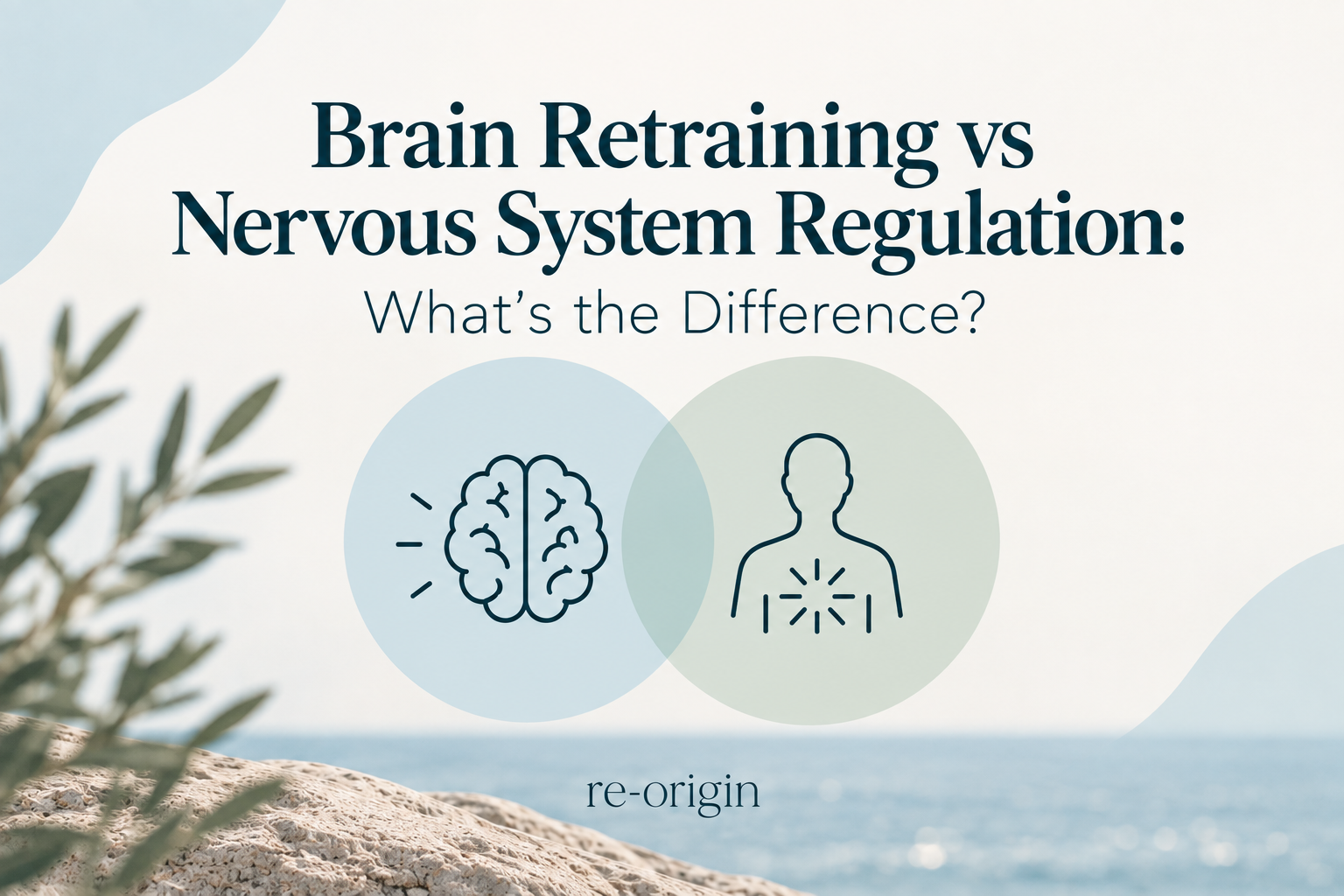
Brain Retraining vs Nervous System Regulation
The two overlap, but they are not identical.
Nervous system regulation tends to focus more directly on what is happening in the present moment and increasing flexibility in how somebody responds to different states.
Brain retraining places more deliberate emphasis on recurring learned patterns and what repeated experiences may teach the nervous system over time.
A regulation practice can create new learning, and brain retraining may include regulation techniques. They do not need to be treated as competing approaches.
It is also worth pointing out that regulation does not simply mean becoming calm. A flexible nervous system needs to be able to mobilise when action is appropriate as well as settle when it is not.
Read our full comparison of brain retraining vs nervous system regulation.
What Brain Retraining Looks Like at re-origin
At re-origin, brain retraining is used alongside education about neuroplasticity, nervous system regulation and body-based practices.
We look at the broader pattern rather than focusing only on a person’s thoughts. That can include what somebody notices, what they predict or interpret, what happens in the body, where attention goes next and what behaviour follows.
The aim is not to force positive thoughts or teach somebody that they should feel calm all the time. It is to recognise patterns that have become highly familiar and create opportunities to practise something different.
That matters because the most useful starting point will not necessarily be the same for everyone.
For one person, the important pattern may involve constantly monitoring physical sensations. For somebody else it might be avoidance, reassurance seeking, expecting rejection, overanalysing a situation or becoming highly focused on signs of danger.
Retraining is therefore less about finding one perfect exercise and more about understanding the pattern you are working with and repeatedly giving the nervous system different information.
For readers who want to understand what a structured programme can contain, we explain how a brain rewiring programme works in more detail.
Brain retraining is educational and skills based. It does not replace medical diagnosis, treatment or psychotherapy where those are needed.
What Is Brain Retraining in Simple Terms?
Brain retraining is deliberate learning.
The nervous system changes through experience. Repeated experiences can make particular responses increasingly familiar and automatic, while further learning can sometimes change how those responses unfold.
Neuroplasticity gives us the biological capacity for change.
What it does not give us is a guarantee that every pattern can be changed in the same way, that every symptom is learned or that every programme claiming to use neuroplasticity is equally well supported.
Understanding both sides of that equation gives us a much more realistic foundation for brain retraining.
Explore Brain Retraining at re-origin
If you want to move from understanding the science to practising it, the re-origin Program + Community combines structured brain retraining with neuroplasticity education, nervous system practices, live classes and community support.
The information in this article is educational and is not a substitute for medical diagnosis, treatment or mental health care. Seek appropriate professional advice for new, severe, worsening or unexplained symptoms.